
A house’s framing system is a complex network of interconnected components that work together to keep the structure standing strong, distribute weight, and resist environmental forces. Whether you are planning a major renovation or simply want to understand what lies beneath your drywall, here is a breakdown of the various types of framing members in a home.
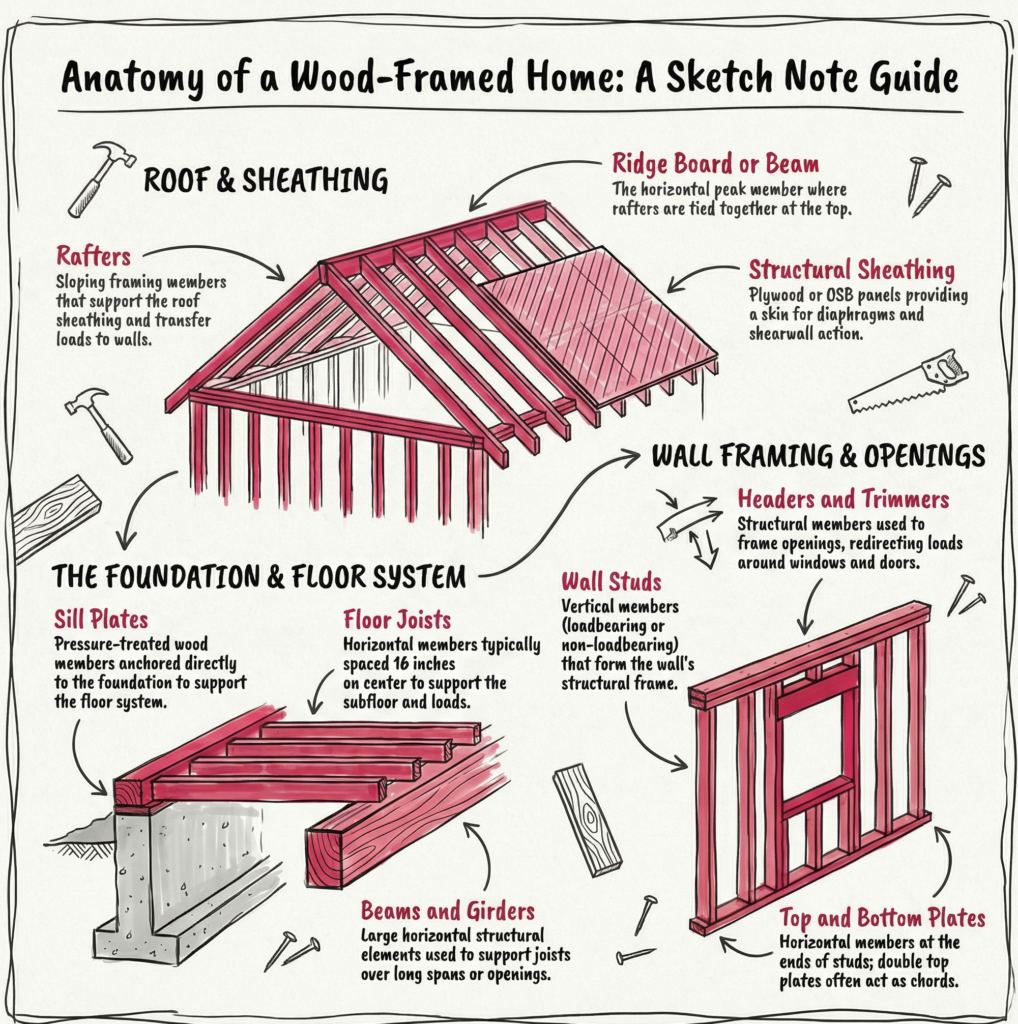
Studs: Studs are the vertical framing members that form the structure of your walls. They are essential for carrying the vertical loads from the roof and upper floors down to the foundation, while also providing resistance against lateral forces like wind and earthquakes. Typically spaced 16 or 24 inches on center, standard walls use continuous studs, but special variations called king studs and jack studs (or cripple studs) are used to frame and support the sides of window and door openings.
Joists: Joists are the horizontal framing members that support your floors and ceilings. Floor joists span the open spaces between foundation walls and interior load-bearing beams to provide a stiff platform for your flooring. While traditionally made of solid sawn lumber, they can also be manufactured as wood I-joists or open-web steel joists. Ceiling joists and roof joists serve a similar horizontal purpose, supporting the ceiling finish below and the roof sheathing above.
Rafters: While a roof joist is horizontal, a rafter is a sloping wood framing member that supports the roof sheathing and encloses an open attic space. Rafters traditionally span continuously from the peak of the roof—where they are often nailed to a central ridge board—down to the exterior roof overhangs. They are often supported mid-span by intermediate struts or dwarf walls to reduce their unbraced length.
Trusses: As a highly efficient alternative to traditional rafter and ceiling joist construction, many homes utilize wood roof trusses. Trusses are complex, prefabricated structural units made of top chords, bottom chords, and internal web members. Because they are meticulously engineered, they can achieve long unsupported spans. The individual lumber pieces in a truss are typically joined together at a factory using galvanized steel connector plates featuring projecting teeth.
Beams: Beams are robust horizontal load-bearing members designed to carry the weight of multiple floor or roof joists. Depending on the span and the weight they need to support, beams can be constructed from steel framing, built-up wood (multiple layers of lumber nailed or bolted together), or structural composite lumber like laminated veneer lumber (LVL).
Headers: A header is essentially a specific type of beam used to span across openings in load-bearing walls, such as over doors and windows. Headers carry the superimposed structural loads from above the opening and safely transfer them down to the adjacent studs on either side.
Sill Plates: Sill plates are the horizontal boards that lay flat on top of concrete or masonry foundation walls. They serve as the critical transition and anchor point where the wood floor framing attaches to the concrete foundation. To prevent decay from ground moisture, sill plates are typically required to be pressure-treated or separated from the concrete by a moisture barrier.
Rim Boards: Also known as rim joists or end joists, rim boards are the outermost members in a floor framing system. They run perpendicular or parallel to the floor joists and wrap around the perimeter of the floor, capping the ends of the joists to provide a solid exterior edge.
Blocking: Blocking consists of short, solid pieces of wood installed between primary framing members like joists or studs. Blocking serves several vital functions: it restrains joists to prevent them from twisting or “rolling over” at their supports, provides mid-span lateral support to prevent studs from buckling sideways, and offers a solid backing for attaching other materials or hardware.